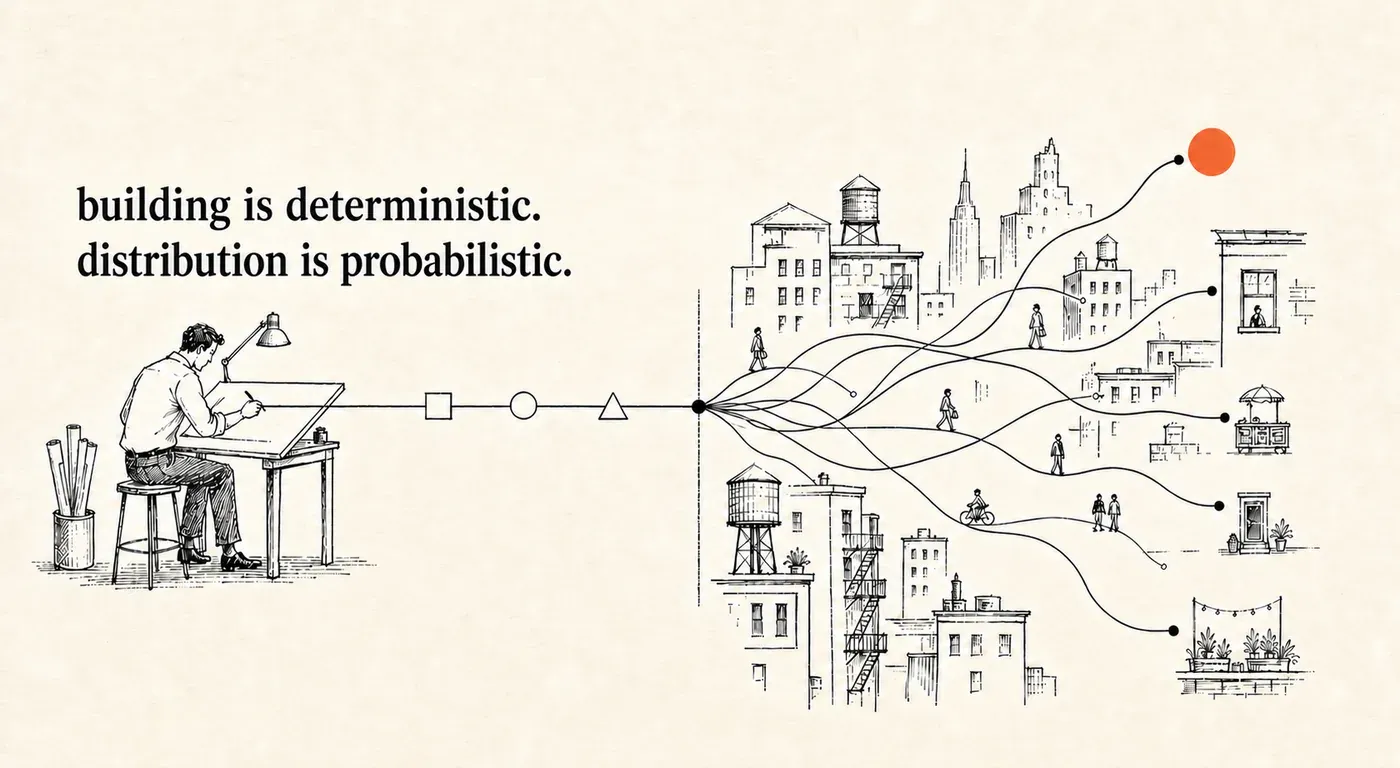
I think it’s not news to anyone that product builders and inventors (software developers, product managers, designers, scientists, etc.) are famously bad at marketing their creations and selling them.
Why is that? why distribution is particularly difficult for these individuals?
I’m one of these people, and I too have a hard time dealing with distribution.
After thinking about this topic long and hard and noticing days that I wanna cry while working on distribution, I decided to dig deep to understand why.
Really, why?
I’m pretty sure it’s not related to IQ and problem solving skills. Like other builders, I have plenty of both with solid evidence.
I would also rule out the work ethic and hard work as the root cause. I have no trouble working on a project multiple hours every day for multiple years. I have evidence to back this as well.
So if it’s not lack of IQ, problem solving skills and hard work, what is it then?
My conclusion is that the root cause of failure to distribute for builders has something to do with the nature of distribution.
Distribution challenges builder’s identity and expectations.
Developers are really good at precision, at control, logic, and fast feedback loops.
They are trained to play a deterministic game: write the code, run it, and immediately see the result. It compiles or it doesn’t. Bugs are reproducible. Fixes are testable.
In software, the mental model is:
Same input → same code → same output
Distribution is different:
Same post → different day → different mood → different network → different outcome
Distribution is emotional, unpredictable, and impossible to fully control.
You can post or launch and hear nothing for days or weeks if not ever.
You can improve the quality by 10% and see no corresponding increase in reach.
A tiny tweak can blow up. A masterpiece can go unnoticed.
For someone who thrives on immediate validation and logic, that unpredictable feedback loop is difficult to handle.
Learning distribution means embracing uncertainty and rejection.
The physics changes
Coding rewards you for being right.
Distribution rewards you for being interesting, consistent, and human.
When a builder is moving from a product task (like adding a feature or fixing a bug) to a distribution task (like posting content, warm/cold outreach, paid ads) he is moving from a deterministic game to a probabilistic game.
and here is the main problem: when switching between tasks happen, games change, but a shift in mindset to play the new game doesn’t necessarily happen.
And without that shift in mindset, a shift in expectations will not happen either.
Builders get tripped up because they carry a quality expectation from software into a domain where it doesn’t apply.
In a deterministic system, good work should produce the correct result.
But probabilistic systems respond differently:
Good work does not guarantee a good outcome. It just increases the odds of a good outcome.
This gap in expectations makes people quit too early.
The solution is not to become less of an engineer. It is to become an engineer of odds instead of an engineer of absolutes.
You’re still engineering. But the physics changes.
Deterministic engineering changes outcomes. Probabilistic engineering changes the odds of outcomes. Quality still matters, but as a probability shifter, not a success guarantee.
Once that mental switch clicks, all the problem-solving skill and experimentation that make someone a good builder can make them amazing at distribution.
Engineer the uncertainty
How can one engineer uncertainty? by treating uncertainty as a given, then designing loops around it: short feedback cycles, small bets, clear hypotheses, and a low cost of being wrong.
Instead of asking, “Did this work?” ask, “What did I learn?”
Treat every piece of content like a small hypothesis test. If I share this story, topic, or point of view, will anyone engage? Measure learning, not virality. Over time, your odds get a little better.
Track leading indicators:
- Did I post?
- Did I test a new angle?
- Did someone comment?
- Did I learn something I can use next time?
Followers, views, and signups are lagging indicators. They matter, but they are not fully under your control. But the process is something you can control fully.
Give yourself a simple loop:
Create → learn → tweak → repeat
This is still engineering, but applied to uncertainty.
Keep a tiny lab notebook. After each post, write one sentence for each question:
- What did I try?
- What surprised me?
- What will I tweak next?
Every ten posts or so, zoom out. Look for small signals: saves, DMs, thoughtful comments. Even one good reply can be a strong signal.
Recycle what works and change one variable at a time.
Same topic, different hook. Same hook, different format.
Don’t try to optimize everything at once.
Build the habit before judging the result
A simple 30–60–90 day plan can help:
- For the first 30 days, build the habit. Don’t judge the outcomes.
- For the next 30 days, refine two variables, such as the hook and the format.
- For the final 30 days, double down on what has shown some lift.
And mute vanity metrics if they mess with your head.
Did I learn? Not: Did I win?
Treat each post like a scientist, not a defendant. Data can be disappointing, but it should never be humiliating.
Here are ten mantras to help you stay sane:
- I’m not publishing content. I’m collecting data.
- I raise probabilities, not guarantees.
- Every post pays tuition. Even the flops.
- The algorithm isn’t judging me. It’s just returning a signal.
- Consistency beats intensity.
- I optimize the process, not today’s result.
- Distribution is engineering under uncertainty.
- Rejection is a signal, not a verdict.
- My edge compounds.
- My only job today is to learn one thing.
I’m not publishing content. I’m collecting data.
This may be the most important.
You shift from impressing to observing. That lowers the emotional risk and increases the learning velocity.
Optimize the process, not the outcome
The more you obsess over a single outcome, the worse your decision-making gets.
Outcome obsession makes you reactive and anxious. It makes you chase hacks.
Process obsession makes you calm, iterative, and grounded.
Outcome optimization asks:
How do I get 10,000 views today?
Process optimization asks:
Did I show up? Did I test one thing? Did tomorrow’s system improve?
You would never walk into an engineering team and ask, “Why didn’t we ship a billion-dollar feature yesterday?” You would ask about velocity, bugs, learning, and pipelines.
Distribution deserves the same thinking.
Every morning, you can chase a win or refine the machine that wins over a thousand days.
This helps you make a shift from an outcome hunter to a process architect.
The lesson is broader than marketing
Majority are uncomfortable in probabilistic domains. Because humans crave certainty, but reality and life work based on odds.
Developers may feel this mismatch sharply, but the lesson applies to almost every real-world arena. The durable skill is staying rational when feedback is noisy, delayed or absent.
Distribution is less about being born a certain way and more about building tolerance for uncertainty as a skill.
That skill is becoming more important.
As building gets cheaper, more people compete for attention. The world gets noisier. But your job is not to win all attention. It is to matter deeply to a specific few.
If AI commoditizes distribution too, scarcity will shift again: perhaps to insight, product taste, judgment, or trust. When everyone gets better at the individual skills, the differentiator becomes the combination: product plus distribution plus judgment.
So I wouldn’t optimize for the belief that distribution is all that matters forever. I would optimize for learning wherever scarcity moves next.
Right now, I think scarcity is trust, repeatable attention, judgment, and taste. Deciding what to build, understanding why it matters, and earning trust around it are getting rarer.
Think of build trust over years, not weeks. Think like a flywheel, not a funnel:
Build → learn → write → earn trust → attract better users → learn more
That is much harder to copy than a marketing play.
This loop is your engine. If you stop shipping or skip reflection, the engine stops.
Protect time for it like it’s product time.
That is why I built Distronaut.
Distronaut is for builders learning the craft of distribution. Astronauts explore unknown environments, collect data, and adapt. Distribution is exploration too.
Distronaut is an operating system for probabilistic work. It doesn’t guarantee better marketing but it helps you keep learning long enough for the odds to start bending.
In distribution, after one day, randomness is the winner. But after 100 days, patterns emerge.
Don’t forget you’re engineering probabilities.
Say this out loud:
“I don’t control outcomes. I control experiments. My job is to nudge the odds every day.”
Welcome aboard, Distronaut!