Part 1 of a series about things I’ve learned that I find interesting and believe to be true.
I’ve learned a few things through experience and reading that have changed how I understand human behavior.
In this first part, I want to explore a question that seems simple but has enormous implications:
Why do we do what we do?
Many of the problems we face in everyday life come down to our actions: what we do, what we avoid doing, and what we repeatedly do despite knowing better.
I believe understanding the forces behind these actions can help us solve many of these problems.
But before solving anything, we first need to understand what we’re dealing with.
A problem well-stated is halfway solved.
— Charles Kettering
When we keep asking why, we discover more and more about a problem. Each discovery is like a new puzzle piece, helping us build a more accurate picture of the situation.
Sometimes what initially looks like the problem is merely a symptom of something deeper.
For example, someone who procrastinates might appear lazy. But perhaps they’re afraid of failure. Someone who constantly buys things they don’t need might appear financially irresponsible. But perhaps they’re chasing social status or trying to become someone they admire.
In either case, solving the apparent problem without understanding its causes might not get us very far.
The better we understand a problem, the less likely we are to solve the wrong thing.
And when it comes to problems involving human behavior, that means understanding motivation.
Why Do We Do What We Do?
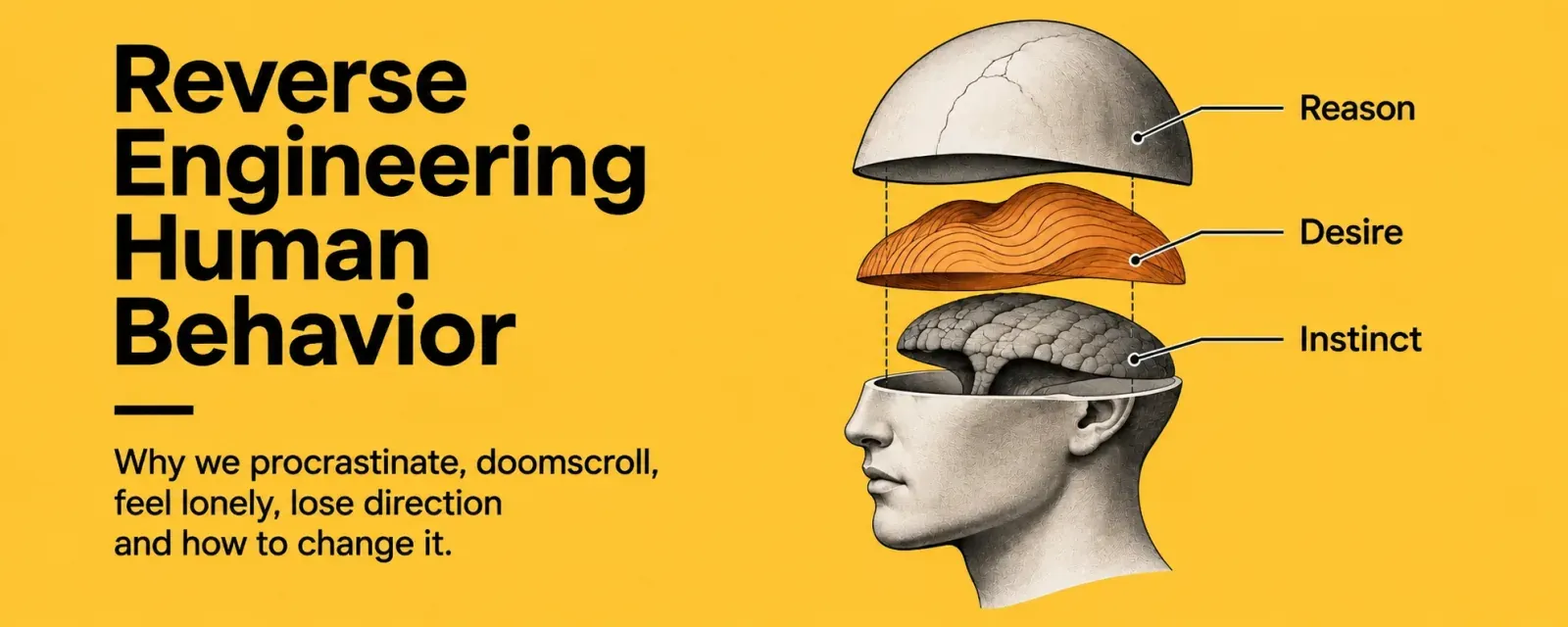
I’ve come to think of human behavior as being influenced by three overlapping forces: instinct, desire, and reason.
- Instinct: Our biological impulses and automatic responses, such as eating when hungry, escaping danger, or seeking comfort.
- Desire: Our emotional wants and cravings, such as pursuing status, wealth, luxury, companionship, or romantic connection.
- Reason: Our ability to deliberately evaluate what is beneficial, right, or worth pursuing, such as studying for an exam, saving money for the future, or acting according to our principles.
These forces frequently overlap, reinforce one another, or compete.
Consider someone who decides to immigrate to another country.
They might be escaping poverty, unemployment, or war (instinct), chasing a better lifestyle and higher social status (desire), and deliberately choosing a place with greater economic opportunities (reason).
One decision, but with multiple motivations.
This distinction is useful because it helps explain why we sometimes act against our better judgment.
We might rationally understand that exercising is good for us, yet desire the comfort of staying home.
We might know that saving money is wise, yet feel compelled to buy something because someone we admire owns it.
Reason can tell us what is worth doing without necessarily making us want to do it.
Where Do Our Desires Come From?
One particularly interesting idea I’ve encountered is mimetic desire, associated with the philosopher René Girard.
The basic idea is that:
We often want things simply because other people want them.
Someone buys a particular car, and suddenly we want one too. Someone achieves professional success, and we begin aspiring to the same career. Someone moves to a desirable neighborhood, and we start imagining ourselves living there.
Our desires are not always as independent as we think.
Of course, not every desire is mimetic. We can want things because they satisfy biological needs, bring personal enjoyment, or align with deeply held values.
But I suspect social imitation plays a much larger role in our lives than we realize.
Naval Ravikant has an interesting observation:
Desire is a contract you make with yourself to be unhappy until you get what you want.
This raises two useful questions:
Why do I want what I want?
And is this desire actually mine, or have I adopted it from someone else?
The Eight Core Drives of Human Motivation
In Actionable Gamification, Yu-kai Chou introduces the Octalysis Framework, which identifies eight core drives of human motivation.
This is a useful framework because it gives us a more detailed vocabulary for understanding why people act.
The eight drives are:
1. Epic Meaning & Calling
The motivation to act because we believe we’re contributing to something greater than ourselves. Examples: Editing Wikipedia for free, volunteering, building something we believe will improve people’s lives.
2. Development & Accomplishment
The motivation to make progress, improve our abilities, overcome challenges, and achieve goals. Examples: Learning a language, earning a professional certification, improving our fitness.
3. Empowerment of Creativity & Feedback
The enjoyment of experimenting, solving problems, creating things, receiving feedback, and adjusting our approach. Examples: Programming, designing products, playing strategy games, solving puzzles.
4. Ownership & Possession
The motivation that comes from having, acquiring, building, or improving something we consider ours. Examples: Accumulating wealth, collecting objects, building a personal library, customizing a home.
5. Social Influence & Relatedness
The influence of relationships, belonging, mentorship, competition, envy, and social recognition. Examples: Making friends, finding a partner, competing in sports, keeping up with the Joneses.
6. Scarcity & Impatience
The desire for something that is unavailable, difficult to obtain, or exclusive. Examples: Limited-time offers, exclusive memberships, rare collectibles.
7. Unpredictability & Curiosity
The motivation to discover what happens next, especially when outcomes and rewards are uncertain. Examples: Slot machines, social media feeds, mystery novels, exploring unfamiliar subjects.
8. Loss & Avoidance
The motivation to avoid losing something valuable or experiencing undesirable consequences. Examples: Avoiding unemployment, protecting our savings, escaping dangerous situations.
These eight drives are not neatly divided into instinct, desire, and reason. Curiosity can be both emotional and intellectual. Accomplishment can be rational, emotional, or socially motivated.
I think of the three forces as a broad way of understanding human behavior and the eight drives as a more practical way of examining specific motivations.
Applying This to My Own Life
When I look at these drives, I can recognize many of them in my own decisions:
- Marriage: Biological attraction, companionship, love, belonging, and building a life together.
- Immigration: Escaping undesirable circumstances while pursuing better opportunities and personal growth.
- Buying things I don’t necessarily need: Ownership, social influence, curiosity, and sometimes the desire to become a certain kind of person.
- Reading and learning: Curiosity, development, accomplishment, and the satisfaction of understanding something new.
- Building products: Creativity, problem-solving, accomplishment, status, ownership, and the desire to create something meaningful.
- Investing: Financial security, ownership, accomplishment, and the satisfaction of making good decisions.
- Making friends: Companionship, belonging, shared experiences, and social connection.
- Traveling: Curiosity, novelty, relaxation, exploration, and sometimes social status.
What’s particularly interesting is that a single activity can satisfy several motivational drives simultaneously.
Building products, for example, can provide creativity, accomplishment, autonomy, recognition, financial opportunities, and a sense of purpose.
This also means losing an important activity can leave several motivational needs unfulfilled at once.
So far, we’ve mostly been trying to understand motivation.
But understanding becomes far more useful when we can apply it.
Using Motivation to Solve Real Problems
Now that we have a better understanding of why people act, let’s use that knowledge to solve some real problems.
Often people fail to act because they lack motivation. Other times, they have plenty of motivation but experience friction, uncertainty, fear, or conflicting desires.
Instead of relying on willpower alone, we can design environments, incentives, and systems that make desirable behavior more likely.
I find it useful to approach these problems with a four-step process.
A Framework for Changing Behavior
Step 1: Define the behavior.
What exactly is happening, or failing to happen?
Be specific. “I’m lazy” isn’t a useful problem definition. “I intend to exercise three times a week but usually skip my workouts after work” is much better.
Step 2: Identify the forces behind it.
Which motivational drives reward the current behavior?
Which discourage the desired behavior?
Also investigate practical constraints. Is the person afraid, unmotivated, exhausted, confused, or simply unable to act?
Our explanation is a hypothesis until we have evidence supporting it.
Step 3: Change the conditions.
Can we make the desirable behavior easier, more rewarding, more social, or less intimidating?
Can we reduce the rewards and triggers associated with undesirable behavior?
Step 4: Experiment and measure.
Introduce a change, observe the results, and adjust.
Rather than assuming we know what will work, we can treat our solutions as experiments.
Let’s apply this approach to ten common problems.
1. Doomscrolling: Why Can’t We Stop?
The apparent problem: We spend hours scrolling through social media even though we know we’d rather do something else.
The deeper problem: Social media delivers novelty, social feedback, and unpredictable rewards almost immediately. Reading, exercising, and creating often require effort before delivering satisfaction.
Motivational Diagnosis
- Unpredictability & Curiosity: Every swipe offers the possibility of discovering something interesting.
- Social Influence & Relatedness: We want to know what others are doing, discussing, and achieving.
- Loss & Avoidance: Scrolling can help us escape boredom, anxiety, or difficult tasks.
- Scarcity & Impatience: Fear of missing something important encourages frequent checking.
Designing a Solution
Deleting social media can be a good first step, but it doesn’t necessarily address the motivation that made scrolling attractive.
We should investigate what the behavior provides.
If we scroll because we’re bored, we might need a more engaging alternative. If we scroll to escape anxiety, addressing the anxiety may be more useful. If we’re checking out of habit, removing notifications, and introducing friction might be enough.
A practical intervention could combine:
- Eliminate triggers. Disable notifications, log out, delete the app after use, or physically separate yourself from the phone during focused work.
- Provide alternative rewards. Replace scrolling with activities that satisfy curiosity, such as exploring a new subject, reading, or building something.
- Make those alternatives rewarding now. Track discoveries, share what you’ve learned, or create something tangible after each session.
Experiment
For two weeks, replace the first 20 minutes of evening scrolling with curiosity-driven learning.
Measure screen time, completed learning sessions, and subjective satisfaction.
Underlying principle
Don’t just remove an unwanted behavior. Understand what rewards it and find a better way to satisfy the underlying need.
2. Exercise: Why Can’t We Go to the Gym Consistently?
The apparent problem: We know exercise is good for us, but struggle to do it consistently.
The deeper problem: Exercise requires immediate effort, while many of its benefits arrive in the future. Avoiding exercise provides an immediate reward: comfort.
Motivational Diagnosis
- Loss & Avoidance: Avoiding pain, exhaustion, and inconvenience.
- Development & Accomplishment: Wanting physical improvement and progress.
- Social Influence & Relatedness: Wanting to look attractive, belong, or gain recognition.
- Ownership & Possession: Feeling attached to the physical progress we’ve earned.
Designing a Solution
Instead of relying exclusively on distant rewards like being healthier at 60, we can bring rewards closer to the present.
- Join a group class or find a workout partner to introduce companionship and accountability.
- Track lifts, repetitions, or completed workouts to make accomplishment visible.
- Choose activities you genuinely enjoy so exercise becomes rewarding in itself.
- Prepare workout clothes and equipment in advance to reduce the effort required to begin.
A person who doesn’t enjoy lifting weights might consistently attend dance classes, swimming sessions, or group sports.
The point isn’t necessarily to make someone love the gym. It’s to find a sustainable way to achieve the desired outcome.
Experiment
Compare four weeks of solo workouts with four weeks of scheduled group workouts.
Measure attendance, enjoyment, and willingness to continue.
Underlying principle
Attach immediate rewards to activities whose most important benefits arrive in the future.
3. Reading: Why Do We Buy Books but Rarely Finish Them?
The apparent problem: We collect books but often fail to read them.
The deeper problem: Buying a book can provide an immediate sense of becoming the knowledgeable person we aspire to be. Actually acquiring that knowledge requires concentration and sustained effort.
Motivational Diagnosis
- Ownership & Possession: Acquiring books feels rewarding.
- Development & Accomplishment: We want to become more knowledgeable.
- Social Influence & Relatedness: We identify with intelligent, well-read people.
- Loss & Avoidance: We avoid the mental effort required to read difficult material.
Designing a Solution
The key is to shift our rewards from owning knowledge to acquiring and using knowledge.
- Stop treating the number of books purchased or finished as the ultimate measure of progress.
- Track useful ideas learned, understood, and applied.
- Join a reading group where discussing ideas provides social rewards.
- Create something from what you read: a note, an explanation, an experiment, a social post, or a practical application.
Of course, reading purely for enjoyment is valuable too.
Not every book needs to produce a measurable outcome.
Experiment
For 30 days, read for 15 minutes daily and write down one interesting idea afterward.
Measure reading consistency and the number of ideas you can recall or apply.
Underlying principle
Reward the behavior that creates value, not merely the symbols associated with that behavior.
4. Consumerism: Why Do We Buy Things We Don’t Need?
The apparent problem: We sometimes spend money on things that provide little lasting value.
The deeper problem: We don’t always want the product itself. We may want what possessing it represents: status, belonging, competence, beauty, or an imagined future identity.
Motivational Diagnosis
- Social Influence & Relatedness: We see other people enjoying or displaying something.
- Scarcity & Impatience: Limited availability creates urgency.
- Ownership & Possession: Acquisition itself feels rewarding.
- Development & Accomplishment: We imagine a purchase will help us become a better version of ourselves.
Designing a Solution
Instead of immediately suppressing a desire, let’s investigate where it came from.
Before making a significant nonessential purchase, ask:
- Would I still want this if nobody else could see it?
- Did I want it before seeing someone else with it?
- What actual problem will it solve?
- Can I obtain the desired benefit without buying it?
Then introduce a 72-hour waiting period for nonessential purchases.
Redirect status competition from consumption toward creation. Instead of admiring people primarily for what they own, we could place greater value on what they create, learn, or contribute.
Experiment
For a month, record non-essential purchases and the reasons behind them.
Before each purchase, identify whether the motivation is practical utility, pleasure, status, curiosity, or something else.
Thirty days later, reassess how much satisfaction each purchase provided.
Underlying principle
A desire can be powerful without accurately representing what we genuinely need or value.
5. Procrastination: Why Don’t We Start Meaningful Projects?
The apparent problem: We postpone the very projects we claim matter most.
The deeper problem: Important projects often carry uncertainty, identity risk, and the possibility of failure. Small distractions provide predictable relief.
Motivational Diagnosis
- Loss & Avoidance: Starting creates the possibility of failure, embarrassment, or disappointment.
- Development & Accomplishment: We want to achieve something significant.
- Epic Meaning & Calling: We believe our project matters.
- Unpredictability & Curiosity: The outcome is uncertain, which can make the project both exciting and frightening.
Designing a Solution
Our instinct might be to increase the reward.
We tell ourselves how successful, wealthy, or fulfilled we’ll become if we complete the project.
But what if the problem isn’t insufficient reward?
What if the fear of failure is just too strong?
Rather than making the reward more attractive, we could reduce the perceived cost of taking action.
- Replace outcome goals with action goals. For example, “publish three experiments” instead of “build a successful company.”
- Make the first step small enough that failure carries little emotional cost.
- Create short feedback loops that provide evidence of progress.
- Work alongside other people to introduce companionship and accountability.
Consider an aspiring entrepreneur who has postponed launching a product for two years.
Telling them they’ll become wealthy if they succeed probably won’t help much. They already understand the potential reward.
But changing the goal from “build a successful company” to “show a prototype to five potential customers this Friday” makes the next action more concrete and less intimidating.
Experiment
For two weeks, define projects in terms of ambitious outcomes.
For the next two weeks, define them as small, clearly specified actions.
Compare how quickly you start, how many sessions you complete, and how much resistance you experience.
Underlying principle
When fear dominates ambition, reducing the cost of action may be more effective than increasing the reward.
6. Loneliness: Why Is Making Friends Harder as Adults?
The apparent problem: Adults want meaningful friendships but often struggle to form them.
The deeper problem: Friendship requires repeated interactions, time, vulnerability, and the possibility of rejection. Adult life frequently provides fewer natural opportunities for these experiences.
Motivational Diagnosis
- Social Influence & Relatedness: We desire companionship, belonging, and social connection.
- Loss & Avoidance: We fear rejection, awkwardness, or wasting time.
- Scarcity & Impatience: Time and opportunities for interaction can be limited.
- Development & Accomplishment: Shared interests and activities provide opportunities to grow together.
Designing a Solution
We often treat friendship as something that should happen spontaneously.
But perhaps we can design environments where friendships become more likely.
- Prioritize recurring interactions over occasional social events.
- Organize gatherings around shared interests and activities.
- Create small groups where people encounter the same individuals repeatedly.
- Introduce shared projects or challenges that encourage cooperation.
For example, joining a weekly sports club might offer better opportunities for friendship than attending 20 unrelated networking events.
The difference is repeated exposure, shared experiences, cooperation, and growing familiarity.
We’re not trying to force friendship.
We’re creating the conditions under which it can develop.
Experiment
Join a recurring group activity and attend consistently for 12 weeks.
Observe how many familiar connections develop into conversations, invitations, and friendships outside the activity.
Underlying principle
Instead of directly chasing a desired outcome, create the conditions under which it is more likely to emerge.
7. Learning: Why Do We Give Up on Difficult Skills?
The apparent problem: We start learning languages, programming, instruments, or other skills with enthusiasm, then abandon them.
The deeper problem: Beginners often experience considerable difficulty precisely when they have the least evidence of progress.
Motivational Diagnosis
- Development & Accomplishment: We desire competence and mastery.
- Loss & Avoidance: We dislike frustration, embarrassment, and feeling incompetent.
- Social Influence & Relatedness: We compare ourselves with people who are already good.
- Empowerment of Creativity & Feedback: We enjoy solving problems and seeing evidence of improvement.
Designing a Solution
The learning process should generate visible evidence of competence as early as possible.
- Divide the skill into small, meaningful milestones.
- Choose practical projects that demonstrate progress.
- Adjust difficulty so tasks are challenging but achievable.
- Introduce fast feedback through teachers, tools, or peers.
Consider learning a new language.
Studying grammar for six months before speaking might feel discouraging.
But successfully ordering food or holding a short conversation in the first week can provide an immediate sense of accomplishment.
The learner is still a beginner, but now has evidence that improvement is possible.
Experiment
Compare a traditional study plan with a project-based learning plan over 30 days.
Measure practice consistency, objective improvements in ability, and motivation to continue.
Underlying principle
Progress is both the result of motivation and a source of motivation.
8. Career Dissatisfaction: Why Do People Stay in Jobs They Dislike?
The apparent problem: People sometimes remain in careers they find unsatisfying for years or even decades.
The deeper problem: The potential rewards of change are uncertain, while the costs of leaving are immediate and concrete.
Motivational Diagnosis
- Loss & Avoidance: Fear of losing income, stability, or status.
- Ownership & Possession: Attachment to accumulated benefits and professional identity.
- Social Influence & Relatedness: Expectations from family, colleagues, and society.
- Epic Meaning & Calling: Desire for more meaningful work.
- Development & Accomplishment: Desire for growth and new challenges.
Designing a Solution
The solution isn’t necessarily encouraging people to quit their jobs.
It’s reducing uncertainty about alternative paths.
- Identify specifically what makes the current job unsatisfying.
- Test alternatives without immediately sacrificing financial security.
- Build skills and relationships that increase future opportunities.
- Accumulate a financial buffer to reduce the potential consequences of change.
- Replace imagined outcomes with evidence from small experiments.
For example, someone dreaming of becoming a designer could take on a small freelance project before resigning from their current job.
This turns a frightening leap into a sequence of manageable decisions.
And sometimes the experiment reveals that the alternative isn’t actually better, which is also valuable information.
Experiment
Spend 90 days testing an alternative career path while maintaining your current job, where feasible.
Evaluate enjoyment, demonstrated competence, financial viability, and realistic opportunities.
Underlying principle
Reduce uncertainty before asking people to accept greater risk.
9. Inaction: Why Do We Know What’s Good for Us but Fail to Do It?
The apparent problem: We know what we should do: exercise, eat healthier, save money, learn new skills, or work on meaningful projects; but we frequently fail to act accordingly.
The deeper problem: Knowing what’s beneficial doesn’t automatically make us want to do it. Our rational intentions compete with immediate desires, established habits, and the tendency to avoid discomfort.
Motivational Diagnosis
- Loss & Avoidance: We avoid immediate effort, discomfort, embarrassment, or possible failure.
- Unpredictability & Curiosity: Stimulating alternatives like social media, video games, and entertainment capture our attention.
- Development & Accomplishment: We want to improve ourselves, but meaningful progress often takes time.
- Epic Meaning & Calling: We believe an activity matters, yet that belief may not overcome immediate temptations.
- Social Influence & Relatedness: Our environment and the people around us can reinforce or undermine our intentions.
Designing a Solution
The obvious answer is to become more disciplined.
But discipline alone requires repeatedly overcoming competing motivations.
A more practical approach is to redesign the conditions under which decisions happen.
- Reduce friction for desirable actions. Prepare gym clothes the night before, keep healthy food accessible, or leave a book where you’ll see it.
- Increase friction for undesirable actions. Remove distracting apps, disable notifications, or keep your phone in another room.
- Attach immediate rewards to long-term goals. Listen to an enjoyable podcast while exercising or celebrate completed milestones.
- Use social influence in your favor. Surround yourself with people who practice the behaviors you want to develop.
- Turn decisions into routines. Schedule important activities so you don’t have to repeatedly negotiate with yourself.
Consider someone who wants to exercise three times a week but consistently chooses Netflix instead.
They already know exercise is beneficial.
Giving them more information about its health benefits probably won’t accomplish much.
But arranging to meet a friend at the gym every Monday, Wednesday, and Friday changes the motivational equation.
Now exercise provides companionship, accountability, and a sense of accomplishment.
Skipping it also introduces a small social cost.
We’ve made the desirable behavior more immediately rewarding.
Experiment
Track your completion rate for a desired activity over two weeks.
Then introduce one change, such as a fixed schedule, reduced friction, or a workout partner.
Measure whether your consistency improves, then experiment with another intervention.
Underlying principle
Don’t fight human nature. Design around it.
10. Aimlessness: Why Do Successful People Lose Their Direction?
The apparent problem: Someone achieves an important goal, or stops pursuing one, and later feels empty, restless, or directionless.
The deeper problem: A meaningful pursuit can simultaneously provide structure, progress, identity, relationships, challenge, and purpose. When that pursuit ends, several sources of motivation can disappear together.
Motivational Diagnosis
- Epic Meaning & Calling: Wanting to contribute to something larger than ourselves.
- Development & Accomplishment: Wanting to grow, progress, and overcome challenges.
- Empowerment of Creativity & Feedback: Enjoying creation, experimentation, and problem-solving.
- Social Influence & Relatedness: Wanting to belong to an ambitious group or community.
- Loss & Avoidance: Fear of wasting time or choosing the wrong direction.
Designing a Solution
A common response to aimlessness is to search immediately for another grand purpose.
But conviction doesn’t always precede action.
Sometimes conviction develops through exploration, progress, and feedback.
Rather than waiting to discover a perfect mission, we could:
- Identify which aspects of our previous pursuit we found most rewarding.
- Separate the experience we enjoyed from the specific project that provided it.
- Explore several possible directions through small, reversible commitments.
- Spend time with people pursuing similar interests.
- Allow experience and evidence to gradually strengthen our conviction.
Consider someone who spent years building a startup and loved the experience.
After leaving it behind, they might assume they need another startup to regain their sense of purpose.
But perhaps what they loved most wasn’t necessarily running a startup.
Maybe it was creating things, solving difficult problems, working with passionate people, and making visible progress toward an ambitious goal.
Understanding that distinction opens up more possibilities.
The next fulfilling pursuit might be another company, a research project, an engineering team, or an entirely different creative endeavor.
The important thing is understanding which experiences made the previous pursuit meaningful.
Experiment
Over six weeks, explore three different activities or projects that interest you.
Track your energy, engagement, desire to continue, and whether each activity provides progress, connection, creativity, or purpose.
Look for patterns rather than expecting immediate certainty.
Underlying principle
Instead of waiting to discover purpose, engage in activities from which purpose might emerge.
What Can We Learn From These Problems?
Looking across these ten examples, a few recurring patterns emerge.
1. Immediate rewards often defeat delayed rewards.
We know exercise is good for us, but staying on the couch feels better right now.
We know reading can be valuable, but scrolling provides stimulation immediately.
Solution
Make beneficial activities more rewarding in the present.
2. Fear can overpower ambition.
We want to start businesses, change careers, and pursue meaningful projects, but the possibility of failure can prevent us from starting.
Solution
Reduce the cost of action, break large commitments into small experiments, and replace uncertainty with evidence.
3. Social influence shapes more of our behavior than we realize.
We imitate what others want, buy, admire, and pursue.
This can encourage unnecessary consumption, but it can also motivate us to learn, exercise, create, and improve.
Solution
Be deliberate about the people, communities, and environments influencing our desires.
4. Visible progress sustains motivation.
When progress is slow or invisible, motivation often declines.
When we can see ourselves improving, the activity becomes more rewarding.
Solution
Shorten feedback loops and make meaningful progress observable.
5. Our environment often matters more than our intentions.
We can sincerely want to change while repeatedly placing ourselves in situations that reward the opposite behavior.
Solution
Make desirable behaviors easier, undesirable behaviors harder, and beneficial actions part of our routines.
There is a deeper lesson connecting all five patterns:
We often try to change behavior by changing what people know, when we should also examine what they experience.
The person who doesn’t exercise probably already knows exercise is beneficial.
The person who spends hours scrolling probably already knows they could use that time differently.
The person postponing an important project probably already understands its potential value.
More information might help, but information alone is often insufficient.
Their immediate experience may reward the behavior they want to change or make the behavior they want to adopt unnecessarily difficult.
That’s where understanding motivation becomes useful.
Conclusion: Understand Before You Act
The more I learn about human behavior, the more I realize how often we try to solve problems without understanding what causes them.
We tell people to be more disciplined, more ambitious, more social, or more responsible.
But telling someone what to do rarely explains why they’re not already doing it.
Perhaps the problem isn’t a lack of ambition, but a fear of failure.
Perhaps it isn’t laziness, but the absence of immediate rewards.
Perhaps what we think we want isn’t even something we genuinely value, but something we’ve learned to desire from others.
And perhaps the problem isn’t motivation at all, but a practical constraint we haven’t identified.
Understanding these forces doesn’t automatically solve our problems, but it gives us a better starting point.
We can stop assuming that willpower, discipline, or more information is always the answer.
Instead, we can investigate the behavior, identify the forces behind it, change the conditions, and observe what happens.
And when our explanation turns out to be wrong, we can adjust it.
This is how I increasingly like to approach problems involving human behavior: as systems that can be understood, experimented with, and improved.
Not everything in human behavior can be reduced to a simple formula. People are complicated, circumstances differ, and our motivations aren’t always obvious, even to ourselves.
But that’s precisely why understanding should come before intervention.
Understand the behavior. Identify the incentives. Change the conditions. Observe the results.
A problem well-stated really might be halfway solved.