← all book reviews · review 49 / 82
thinking
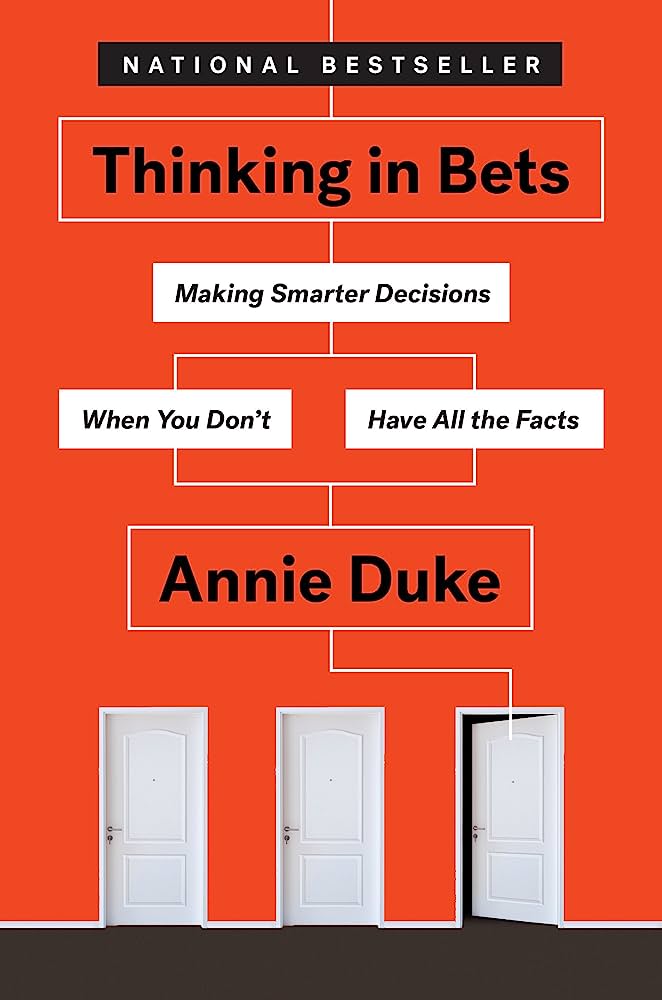
Thinking in Bets
rated 5 out of 5read march 2022
notes · 2 min read

Read Daniel's notes about Thinking in Bets on the booksense app
open booksense →Life is like poker, not chess!
Life decisions are more in the probabilistic domain (involve hidden information, luck and randomness like poker) and not deterministic domain (complete knowledge of the issue and perfect cause and effect relationship like chess).
In probabilistic domains like life decisions, we can get better at decision making by separating outcome quality from decision quality.
There are exactly 2 things that determine how our lives turn out: the quality of our decisions and luck. Learning to recognize the difference between the two is what thinking in bets is all about.
Humans have a tendency to equate the quality of a decision with the quality of its outcome. This tendency is very misleading specially when it comes to learning from the experience.
Poker players have a word for this: Resulting.
Resulting, assuming that our decisions are good or bad based on a small set of outcomes is pretty reasonable strategy for learning in chess. But not in poker, or life.
We make a mistake when we look for lessons in life’s results. Our lives are too short to collect enough data from our own experience to make it easy to dig down into decision quality from the small set of results we experience.
What makes a decision great is not that it has a great outcome. A great decision is the result of a good process, and that process must include an attempt to accurately represent our own state of knowledge.
When we think in advance about the chances of alternative outcomes and make a decision based on those chances, it doesn’t automatically make us wrong when things don’t work out. It just mean that one event in a set of possible futures occurred.
If we aren’t wrong just because things didn’t work out, then we aren’t right just because things turned out well.
Annie Duke I immensely enjoyed the book. Brilliant work. I have built a deeper understanding of how good decision making works, how more accurately confer outcomes, and to see the world through the lens of probability.
Absolutely recommend it to anyone who seeks to improve his/her life simply by making better decisions!
How do you make decisions? Are you just look into outcomes and decide whether it was a good decision or not? Did you read some other book on decision making?
Happy reading! 📙