← all book reviews · review 6 / 82
building
Actionable Gamification
rated 5 out of 5read december 2022
notes · 2 min read

Read Daniel's notes about Actionable Gamification on the booksense app
open booksense →We design and build systems and tools that are inherently function-focused. In our designs, we optimize for functional efficiency and to get the job done quickly.
This is like a factory that assumes its workers will do their jobs because they are required to, not because they necessarily want to perform the associated task.
But that’s not how humans work.
Unlike machines which need and love clear-cut instructions and steps to perform a task, humans hate it when you tell them what to do and exactly how to do it step by step.
We call it micromanagement.
Machines love micromanagement, but humans hate it because it kills our creativity and our sense of autonomy (having meaningful choices and options).
We need motivation for doing stuff.
For thousands of years, we have been playing games. We love playing games. Sometimes we even pay to play some games.
Why is that? Why do we often hate to do the jobs that we are being paid to do and love to play games that we need to pay for?
The answer is in this book: “Human-Focused Design”
Human-focused design at its core emphasizes that people aren’t rudimentary cogs in a system. We have feelings, ambitions, insecurities, and reasons for whether or not we want to do certain things.
Human-focused design optimizes for these feelings, motivations, and engagement as the basic foundation for designing the overall system as well as its functions.
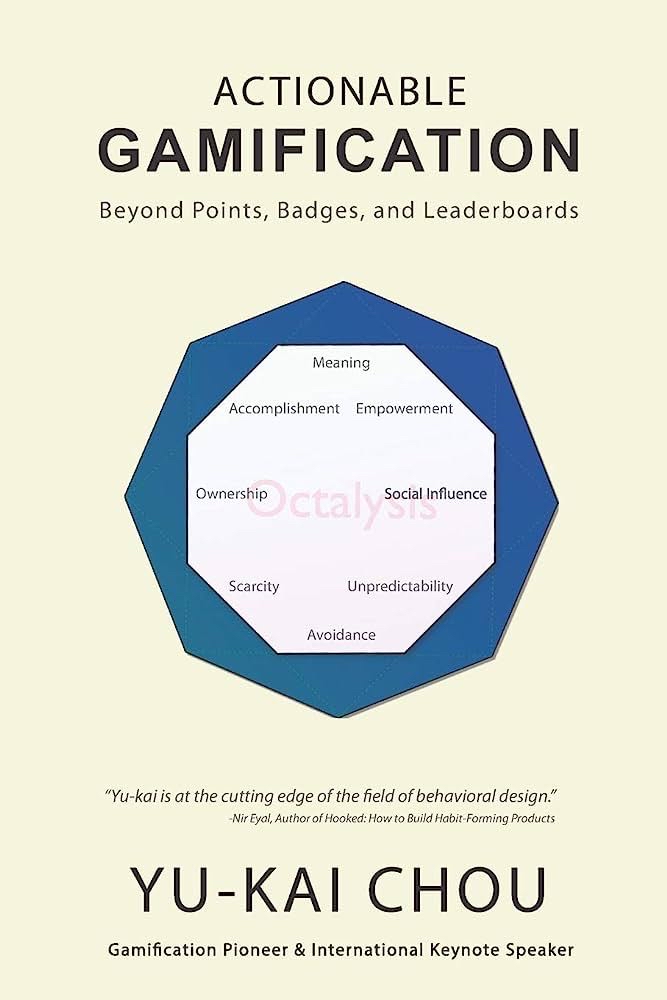
Yu-kai Chou proposes a framework called Octalysis that includes 8 core human drives that motivate us to act:
Epic Meaning & Calling Development & Accomplishment Empowerment of Creativity & Feedback Ownership & Possession Social Influence & Relatedness Scarcity & Impatience Unpredictability & Curiosity Loss & Avoidance
These are the 8 core drives of human motivation which makes us take action.
The other name for this book could be: “Applied Psychology”
Well, it was the most insightful, engaging, and actionable psychology book that I’ve ever read.
It was around 500 pages, and it took me 45 reading sessions and 31 hours to read.
I enjoyed it very much and I intend to use it in a project of mine.
Yu-kai Chou brilliant work!
Happy holidays & Happy reading! 📙